The Game Isn't Over, But the Rules Have Changed
Last year, the global video game industry made more money than it ever has before. Nearly two trillion dollars. A record high.
And yet, if you talk to many developers and publishers in the West, in places like Los Angeles or London or Stockholm, it feels like a recession. Studios are struggling, projects are being canceled, layoffs continue. So, where did all that money go? Who’s actually winning?
That’s the paradox at the heart of a major new analysis by Matthew Ball, a leading thinker on the metaverse and former head of strategy at Amazon Studios. He’s just published his massive, chart-filled annual report on the state of the industry. And the picture it paints is of an industry undergoing a seismic, and deeply uneven, transformation.
The short answer to that ‘where’s the money’ question? It’s flowing to places that might surprise you. And it’s flowing away from the traditional centers of power.
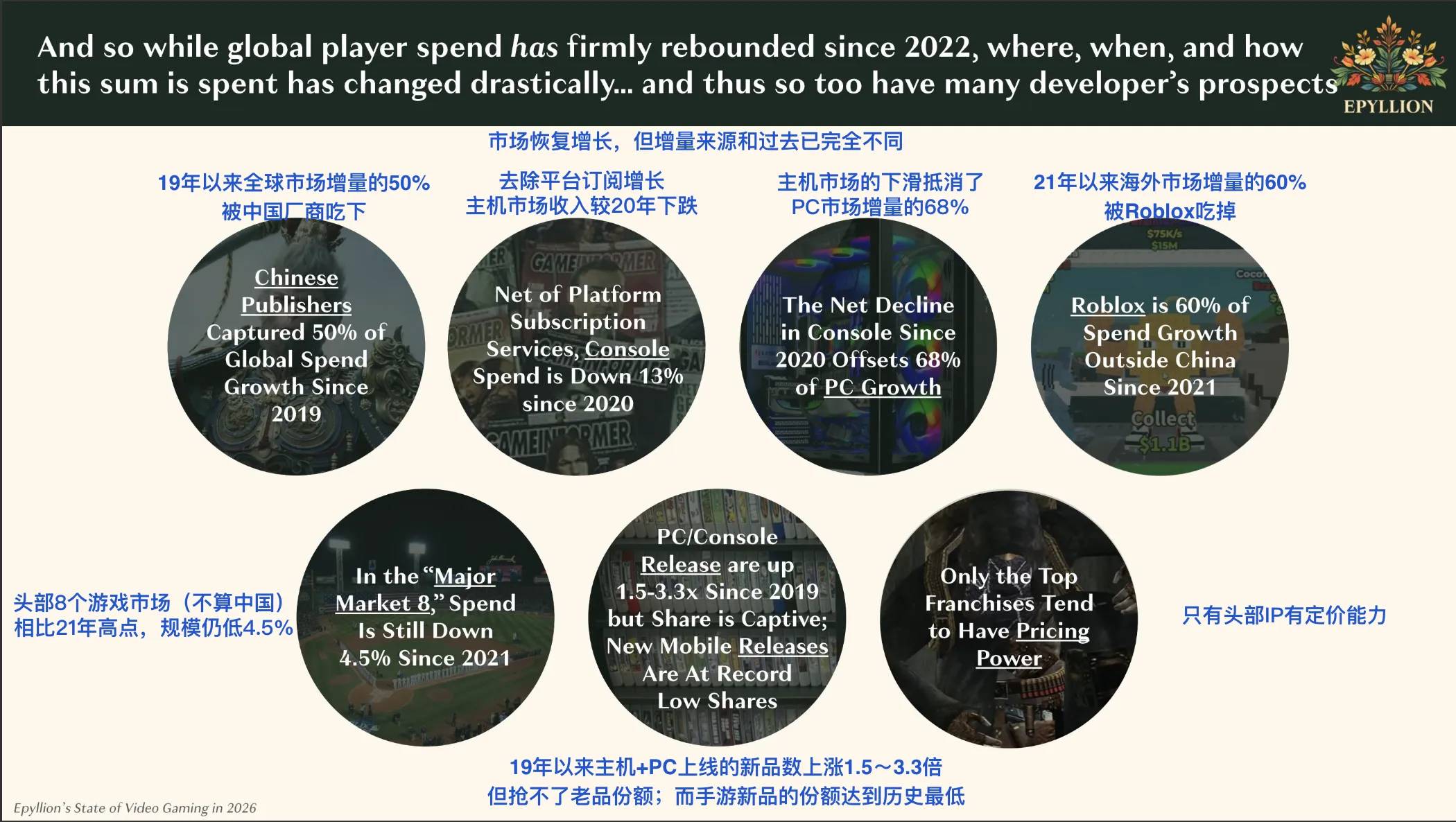
Let’s break it down. In 2025, the industry grew by about 97 billion dollars. Matthew Ball’s analysis shows that nearly forty percent of that new money was made in China, by Chinese companies. Another twenty-two percent came from Chinese games succeeding overseas. A quarter of the entire global growth was captured by just one platform: Roblox. And a sizable chunk came from console subscription services—money that goes to Sony and Microsoft, not necessarily to the game makers on their platforms.
What’s left for the traditional Western studios and publishers, the ones who defined the last era of gaming? Almost nothing. The pie got bigger, but their slice stayed the same—or shrank.
This reveals a fundamental shift. For decades, the industry was driven by premium console games from big studios, sold primarily to affluent players in North America, Europe, and Japan. That engine is sputtering. The new growth is coming from developing markets, from PC gaming, and from platforms that look less like traditional games and more like social networks.
Consider the PC. While console revenue for game makers has actually fallen, the PC market has grown steadily. It’s become a refuge. And on platforms like Steam, a brutal ‘winner-takes-most’ dynamic is hardening. Players are spending nearly half their time with games that are over nine years old. With thousands of new titles releasing every year, breaking through is astronomically difficult.
Then there’s Roblox. It’s not just a game; it’s a black hole for attention. Its users now spend more combined hours on it than on Steam, PlayStation, and Fortnite put together. It’s nearing Netflix levels of engagement. And it’s monetizing that attention with terrifying efficiency, especially among younger players in developing markets. It contributed a staggering sixty percent of the industry’s growth outside China since 2021.
But the competition isn’t just other games. Ball spends a significant part of his report on what he calls the ‘attention war.’ In mature markets like the U.S., the real rivals aren’t just other studios. They’re TikTok, sure. But also OnlyFans. Online sports betting. Cryptocurrency trading apps. AI-powered companion and role-playing tools.
These are all vying for the same finite resource: the time and disposable income of a young, tech-savvy user, typically a man under 35. The data shows this group is three to four times more likely to be active on these alternative platforms than the average person. And they’re reporting that they’re gaming less. The thrill of a loot box is being outcompeted by the adrenaline of a sports bet or the personalized feed of a creator economy platform.
It’s a landscape that feels familiar to anyone who watched China’s internet scene five years ago, when it exploded. The West is now going through its own version of that fragmentation.
So, what’s a game company to do? The strategies emerging are pragmatic, and sometimes painful. There’s a massive push toward in-game advertising, even on PC and console, to monetize players who won’t pay upfront. There’s a rush to build direct-to-consumer payment systems, to bypass the hefty cuts taken by app stores and platforms. And, tellingly, there’s a wave of outsourcing—not just for art or code, but for creative design and direction—to studios in regions with lower costs.
The most successful new titles Ball highlights, like Hades II or Palworld, were often built by small core teams leveraging extensive global networks of contractors.
What Matthew Ball’s report ultimately argues is that the word ‘gaming’ no longer describes a single, coherent industry. It’s a catch-all term for several different industries that happen to share a screen. The business of making a sprawling, narrative-driven PC game like Black Myth: Wukong has almost nothing in common with the business of running a live-service mobile title, which has nothing in common with cultivating a UGC platform like Roblox.
They have different audiences, different economic models, different creative processes. And they’re fighting different wars for attention.
The old growth story—more players, better graphics, bigger consoles—is over. The new story is about fragmentation, adaptation, and a brutal reordering of who gets to profit from play. The game continues. But the board has been completely redrawn.